Skip to content
HATICE Healthy AgingThrough Internet Counsellingin the Elderly

Collaborative project co-funded by the European Unions' Seventh Framework Programme (FP7, 2007-2013) under grant agreement No 305374.

Flag of the European Union FP7 Cooperation logo

HATICE is the first major research project following the launch of the European Dementia Prevention Initiative (EDPI) in 2011. Cardiovascular risk factors including hypertension, diabetes, obesity, smoking and lack of physical exercise are common in the elderly and increase the risk of myocardial infarction, stroke and dementia.

Main aims of HATICE:
  1. Develop an innovative, interactive internet intervention platform to optimise treatment of cardiovascular disease in the elderly
  2. Test this new intervention in a randomised controlled trial to investigate whether new cardiovascular disease and cognitive decline can be prevented

HATICE, page 6 of 6

HATICE represented at the 20th WONCA Europe conference
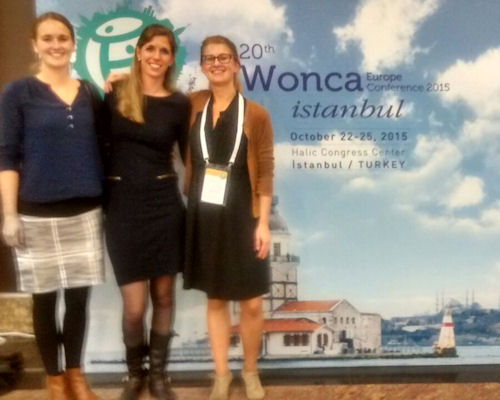
WONCA Europe conference 2015

From October 21st to October 25th 2015 the WONCA (World Organization of Family Doctors) Europe conference took place in Istanbul. In this large event, over 3,500 general practitioners from Europe and beyond gathered to exchange scientific, clinical and organizational knowledge. Three HATICE PhD students from the Netherlands attended the conference. Susan Jongstra presented the protocol of the HATICE-trial and Cathrien Beishuizen presented the results of a meta-analysis on internet-interventions for older people. Throughout the conference, there was considerable attention for cardiovascular prevention, risk management and eHealth.

A good environment to promote HATICE!

HATICE at 7th Kuopio Alzheimer symposium

On 11-13 June the 7th Kuopio Alzheimer symposium was held. With 24-hour daylight in the sky, inside the Technopolis centre in Kuopio important discussions took place on Alzheimer’s disease research. HATICE was well-represented. Hilkka Soininen was chair of the organization committee.

Miia Kivipelto presented encouraging data on the recently published FINGER trial, which illustrated the proof of principle of the effect of a multidomain intervention on cognitive functioning. Sandrine Andrieu presented some interesting lessons learned from the MAPT trial, which is currently under analysis. Edo Richard presented preliminary data on preDIVA, which is also under analysis at this very moment. HATICE was discussed extensively. All in all the theme dementia prevention was high on the agenda and led to lively discussions.

All are very much looking forward to the final results of MAPT and preDIVA later this year.